
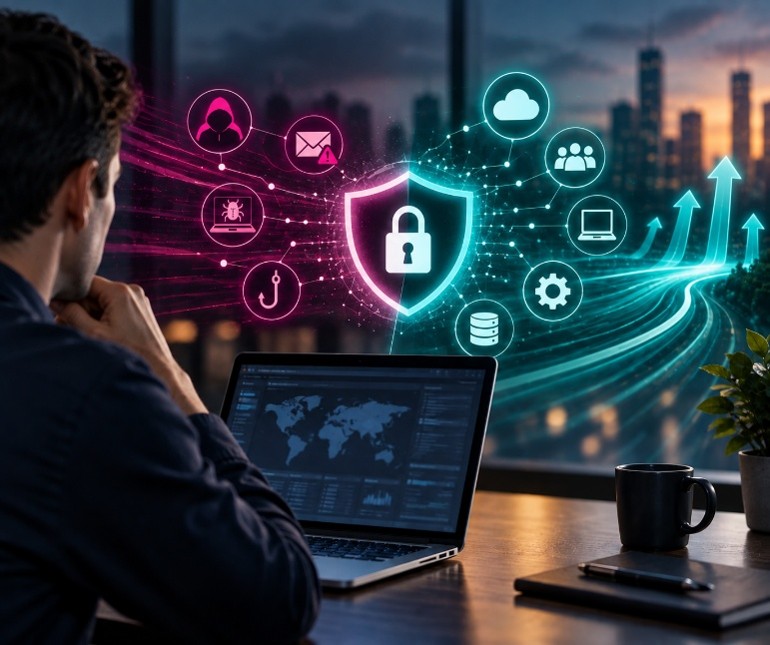
Cyber Threats Are Changing. Are You Ready?
Cybersecurity has always been a moving target. But today, the pace of change feels different.
Artificial intelligence is giving businesses powerful new capabilities while also providing cybercriminals with new ways to create convincing scams, automate attacks, and target organizations more efficiently. Employees are working from more locations and devices. Businesses rely heavily on cloud applications. And the amount of valuable data organizations create, store, and share continues to grow.
For small and midsize businesses, the message is clear: yesterday’s cybersecurity strategy may not be enough for tomorrow’s threats.
Being prepared doesn’t mean predicting exactly what the next cyberattack will look like. It means building a security strategy capable of adapting when the threat landscape changes.
Cybercriminals Are Evolving, Too
Cyberattacks aren’t limited to someone manually trying to “hack” into a computer.
Modern attacks often focus on people, identities, and access.
Phishing emails can impersonate executives, vendors, or coworkers. Stolen credentials can provide access to cloud applications. Social engineering can convince employees to share information or approve fraudulent requests.
AI adds another layer.
Attackers can use AI to create more convincing emails and messages, improve impersonation attempts, and generate content quickly and at scale. This makes the old advice of simply looking for spelling mistakes or poorly written emails increasingly unreliable.
Businesses need to assume that scams will continue becoming more polished and difficult to recognize.
Your Perimeter Has Changed
There was a time when cybersecurity largely focused on protecting what was inside the office network.
Today, the “office” can be almost anywhere.
Employees access company information from laptops, smartphones, home offices, hotels, client locations, and cloud applications. Microsoft 365 and other SaaS platforms contain critical business information that may never touch an organization’s physical network.
As a result, cybersecurity needs to protect users, devices, identities, applications, and data, not simply the network itself.
That means businesses should continually evaluate who has access to information, how that access is protected, and what happens when something suspicious occurs.
One Security Tool Isn’t Enough
There is no single cybersecurity product capable of protecting a business from every threat.
Strong security relies on layers.
Multi-factor authentication can help protect accounts when passwords are compromised. Endpoint security can help identify suspicious activity on computers. Email security can help detect malicious messages. Security monitoring can provide visibility into potential threats. Backups can help organizations recover when data is lost, corrupted, or compromised.
Employee education is another critical layer.
Even with strong technology in place, employees regularly interact with email, websites, files, login requests, and sensitive information. Helping them recognize suspicious activity and know when to ask for help can make a significant difference.
The goal isn’t to eliminate every possible risk. That’s unrealistic.
The goal is to make your organization more difficult to compromise and better prepared to respond when something happens.
Don’t Forget About the Basics
With so much conversation around AI and emerging threats, it’s easy to overlook fundamental cybersecurity practices.
But the basics still matter.
Software should be regularly patched. Old user accounts should be disabled. Administrative access should be limited. Password practices should be strengthened. MFA should be implemented where appropriate. Devices should be monitored and protected. Critical data should be backed up.
Businesses should also know what technology they have.
An outdated computer, forgotten cloud account, unsupported application, or unmanaged device can create an unnecessary security gap.
Cybersecurity maturity often comes from consistently doing the fundamentals well rather than constantly chasing the newest security trend.
Visibility Is Critical
You can’t respond to something you don’t know is happening.
Modern cybersecurity increasingly depends on visibility across an organization’s technology environment.
What devices are connecting to your systems? Who is logging into accounts? Are there unusual authentication attempts? Has security software detected suspicious activity? Are critical systems properly patched?
For many small businesses, having someone actively monitoring these signals around the clock isn’t realistic internally.
That’s where managed security tools and professional monitoring can play an important role. Instead of relying exclusively on an employee noticing something unusual, organizations can build processes designed to identify potential threats earlier.
Have a Plan for When Something Goes Wrong
One of the biggest cybersecurity mistakes a business can make is waiting for an incident before deciding how to respond.
Ask the questions now.
Who should an employee contact if they click a suspicious link? What happens if an account is compromised? Who makes decisions during a security incident? Where are backups stored? How quickly can critical systems be restored? How will customers, vendors, or employees be notified if necessary?
An incident response plan doesn’t need to predict every scenario. It should provide enough structure that your team isn’t starting from scratch during a stressful situation.
Prepare for What’s Next
Cybersecurity will continue evolving. The specific threats, technologies, and tactics will change, but the need for a strong security foundation won’t.
At Team ITS, we help businesses take a proactive, layered approach to cybersecurity—from endpoint and email protection to security monitoring, backups, employee awareness, identity protection, and ongoing IT management.
The most important question isn’t whether cybersecurity will look different a year from now.
It will.
The question is whether your business has the technology, processes, visibility, and support needed to evolve with it.
Is your business prepared for what’s next? Talk with Team ITS about strengthening your cybersecurity strategy today.
TEAM ITS, LLC has been serving the Central and Southern Illinois area since 2016, providing IT Support such as technical helpdesk support, computer support and consulting to small and medium-sized businesses. Book a complimentary consultation today.


Leave a Reply
Want to join the discussion?Feel free to contribute!